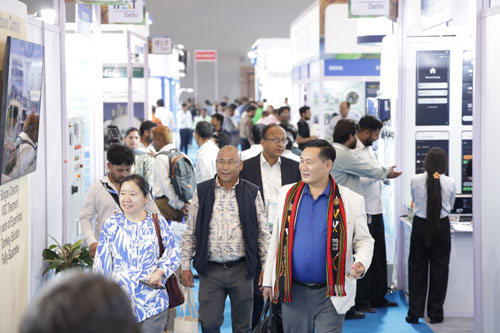
New Delhi, April 25, 2026: IFAT Delhi 2026, held from April 22 to 24 at Bharat Mandapam, marked the inaugural edition of the IFAT platform in the national capital—extending the legacy of IFAT India, which has been traditionally hosted in Mumbai. The launch of the Delhi edition reflects a strategic shift to bring the platform closer to policy centres and North India’s fast-evolving project landscape.
Organised by Messe Muenchen India, from the outset, the event signalled a market that is no longer exploring environmental solutions but actively moving toward execution. The focus across the three days was firmly on technologies that are ready to be implemented and scaled, aligning with the immediate infrastructure demands emerging across cities and industries.
IFAT Delhi witnessed participation of 77exhibitors, presenting more than 500 technologies and solutions. The two show together attracted upwards of 6,200 trade visitors, including active participation from key buyer groups, including municipal corporations, smart city representatives, industrial end-users, and ESG-focused procurement teams as well as stakeholders from the beverage and food processing industries with a strong interest in water and wastewater solutions.
What distinguished this inaugural Delhi edition was its clear orientation toward deployable solutions, building on the foundation established by IFAT India in Mumbai but adapting it to a more execution-focused audience. Across water, wastewater, solid waste, air quality, and waste-to-energy segments, exhibitors prioritised systems designed for immediate application. These included modular treatment units, decentralised wastewater technologies, automated waste sorting systems, and real-time monitoring platforms tailored to Indian operating conditions and regulatory frameworks.
The exhibition floor functioned as a working marketplace rather than a display environment. Decision-makers—including city officials, EPC contractors, and corporate procurement leaders—engaged directly with solution providers. Conversations moved quickly from product understanding to discussions around pilots and project feasibility.
As Bhupinder Singh, President – IMEA, Messe München and CEO, Messe Muenchen India, noted, launching IFAT in Delhi is a response to how quickly demand is evolving on the ground. “With IFAT Delhi, our focus was to bring the platform closer to where a significant part of policy direction and project planning is happening. What we’re seeing today is not a future opportunity—it’s immediate demand, and the conversations here reflect that shift toward execution.”
Echoing this, Katharina Schlegel, Global Industry Lead IFAT, emphasised the importance of extending the IFAT network into new geographies within India. “Taking IFAT to Delhi for the first time is a natural next step for us. India is moving quickly from policy to implementation, and the right technologies and partners must be part of that process early on. Expanding the platform allows us to support that transition more effectively.”
New Delhi, July 25, 2025 – India’s rapid growth across industries and infrastructure sectors have also put the spotlight on the environment impact of this growth. Against this backdrop, IFAT Delhi is set to debut in the nation’s capital from April 22–24, 2026, at Bharat Mandapam, marking a new chapter in India’s sustainability movement. For almost 60 years, IFAT has served as the global launchpad for environmental innovation, and in India, its legacy is well established. 11 successful editions in Mumbai have proven that when the right people come together—technology experts, policymakers, municipal leaders—real, lasting change can follow. Now, Messe Muenchen India is bringing that momentum to Delhi.
Alongside the exhibition, a structured conference programme ran across April 22 and 23, anchoring the event in real-world policy and industry challenges. Day one opened with a plenary on urban water security moderated by Dr. Nupur Bahadur, brought insights from Mr. Rajiv Ranjan Mishra, IAS (Retd.), former DG, NMCG; Dr. Sabita Madhvi Singh, Director, Ministry of Jal Shakti; and Mr. V. K. Chaurasia, CPHEEO–MoHUA, highlighting policy and governance priorities. Technical innovations were discussed in sessions on Sludge Management and Compressed Biogas from Municipal Solid Waste, featuring experts such as Dr. Indra N. Mitra (Cambi India) and Mr. Gaurav Kedia (Indian Biogas Association). The India–EU Water Partnership session, chaired by Mr. Arturo Cadena (GIZ), underscored international cooperation with participation from Ms. Laura Sustersic (GIZ) and Mr. Thomas Roger McClenaghan, EU Delegation. Deliberations concluded with discussions on legacy waste remediation, decentralised wastewater treatment, and a Policy Panel on India’s SWM 2026 roadmap, reinforcing scalable and future-ready solutions for India’s water and waste sectors.
Day two shifted focus toward the beverage and processing industries, addressing packaging circularity, decarbonisation pathways, supply chain transformation, and modernisation challenges. Sessions such as “Circular or Chaos?” and “Net Zero or Not Yet?” reflected increasing regulatory and market pressure on industry to align with sustainability goals. Together, the programme reinforced the event’s positioning as a platform where policy direction, industry response, and technology solutions converge into implementable pathways.
With growing pressure on industries to align with EPR mandates, pollution control norms, and municipal waste processing targets, North India is fast becoming a critical frontier in India’s environmental compliance story. That’s where IFAT Delhi 2026 comes in. By planting its second flagship firmly in the capital, Messe Muenchen India is bridging a crucial access gap.
As the first edition of IFAT Delhi, exhibitor feedback pointed to a market that engaged with clear intent rather than exploratory interest. The conversations were largely anchored in live requirements, with municipal bodies, industrial clusters, and EPC players initiating discussions around pilots, trial installations, and performance-linked procurement models from the outset.
Harald Kleiven, Sales Director – Emerging Markets, Cambi said, “IFAT Delhi has been an exceptional experience. The event provided us with an outstanding platform to connect directly with key decision-makers, including representatives from municipal corporations, Jal Boards and leading consultants, as well as potential process and equipment partners. It has opened up valuable avenues for future collaboration.”
From the solid waste management segment, Saurabh Aggarwal, Managing Director, DCC Group of Companies stated, “IFAT Delhi has completely surpassed our expectations. For an inaugural edition, the turnout of high-quality visitors and new prospects was exceptional. This is easily one of the best exhibitions we have ever participated in. We are massive advocates of the IFAT brand and look forward to exhibiting at their shows globally—whether in Mumbai, Africa or Saudi Arabia.”
Rajiv Ranjan Mishra, Former Director General, National Mission for Clean Ganga (NMCG), Chief Advisor, Chairperson, IFAT India National Advisory Committee (NAC) said, “Having been associated with the IFAT for long, I am pleased to see it expand to New Delhi. This edition is perfectly positioned to bridge the gap between the technology providers, policymakers and the public sector. It is a truly unique platform that brings together an exceptional mix of researchers, businesses and government officials, making it the ideal place to explore cutting-edge environmental solutions.”
While large-scale contract closures will follow longer procurement cycles, the inaugural edition has succeeded in creating a credible pipeline of opportunities expected to progress in the coming months. Across sectors, a clear preference emerged for integrated offerings. Buyers were evaluating solutions that combine technology, operations and maintenance, and financing models—prioritising reduced implementation risk, regulatory compliance, and predictable lifecycle costs.
Hosting the event in New Delhi enabled closer alignment with national policy frameworks and funding priorities. This was particularly relevant in areas such as water reuse, solid waste management, and urban resilience—sectors where regulatory clarity and government backing play a critical role in project execution. This proximity to policymakers and central agencies is expected to support faster approvals for pilot projects and accelerate adoption timelines.
Building on the momentum of the Delhi edition, the next chapter will unfold at IFAT India 2026, scheduled from September 9–11 at the Bombay Exhibition Centre. The Mumbai edition is expected to bring together a broader national and international ecosystem, continuing to drive the development of environmental infrastructure in India with a clear focus on execution and scale.
About IFAT Worldwide
Messe München not only demonstrates its considerable expertise in organising environmental technology trade shows with the world’s leading trade fair, IFAT Munich. Other international events include IE expo China in Shanghai, IE expo Chengdu in Chengdu, IE expo Guangzhou in Guangzhou, IE expo Shenzhen in Shenzhen, IFAT Africa in Johannesburg, IFAT Eurasia in Istanbul, IFAT Saudi Arabia, IFAT Delhi in New Delhi, IFAT India in Mumbai, Singapore International Water Week (in cooperation with IFAT) in Singapore as well as IFAT Brasil in São Paulo. Together, the 12 IFAT events form the world’s largest network for environmental technologies.
About Messe München GmbH
Messe München is one of the largest trade fair companies worldwide and a facility operator of the Munich Exhibition Center, the ICM – International Congress Center, and the CCN – Conference Center North Messe München in Munich Riem, as well as the MOC – Event Center Messe München located in the north of Munich. With around 70 foreign representations and a network of affiliated companies in Europe, Asia and South America, it has a successful global presence covering more than 100 countries and is at the forefront of facilitating global business connections.
About Messe Muenchen India:
Founded in 2007 as a wholly owned subsidiary of Messe München GmbH, Messe Muenchen India is one of the country’s biggest B2B trade fair organisers. With a diverse portfolio of 25+ large-scale B2B trade fairs, spanning consumer goods, capital goods, emerging technologies, environmental solutions, energy sector, it serves both the Indian industry and global markets. The company hosts powerful industry events, including electronica India, productronica India, bauma CONEXPO India, IFAT India, analytica Lab India and many more, fostering innovation, business growth, and strategic networking.